
Options for Taking Externally Delivered Credit Courses
While WISDOM supports only 100% parent directed education, high school students with WISDOM have some opportunities to take externally delivered credit courses through another school authority. There are two predominant options that support this choice:
Non-Primary Registration Fully Funded
WISDOM students may take up to 5 credits through any school in Alberta that offers online or paper based distance education. These 5 credits are fully funded and do not affect the student’s Home Education program.
Shared Responsibility with Another School WISDOM Fee By Percentage
A student who engages in Shared Responsibility with an outside school authority can take externally delivered credit courses. To cover the funding loss, WISDOM charges a support fee based on the percentage of education taken from the partnership school.
Non-Primary Registration with Another School (600/622 or 623 option):
With this option, WISDOM students are considered to be 100% Home Education students, and are fully funded by Alberta Education for their Home Education program. A student can enroll as a Non-Primary student with another school in Alberta (not including your local school) that offers online or paper-based Distance Education and take up to 5 credits worth of courses. WISDOM retains the primary registration of the student, and Alberta Education will also fully fund the other school school authority to deliver up to 5 credits (equivalent to one core-course). Students must be registered prior to term start dates for courses. Certain schools will also allow students to enroll in more than 5 credits worth of courses by charging the student a fee per credit taken (usually about $125 per credit).
Enrollment Process for Non-Primary Registration:
Student enrolls with WISDOM as normal, then contacts the other school authority to enroll as a non-primary registration student for up to 5 credits (or more if paying for courses). Students must enroll as a Non-Primary student before the term 1 or term 2 deadlines depending on which term the credit course falls in.
Pros:
- Students retain 100% Home Education status.
- Courses are teacher-directed and totally organized by the other school authority.
- Can be a good option for students who need extra support.
- This option is fully funded by Alberta Education.
- Some courses have flexible programming and students can work at their own pace.
- Opportunity to complete off-campus courses with this option (RAP, Green certificate, etc.).
Cons:
- Limited to 5 credits per year.
- Some courses lean heavily into independent study with limited support.
- Some courses follow a strict schedule which may be cumbersome to some students.
- Course delivery method might not fit the student's learning style.
Shared Responsibility with Another School (611/612 option):
WISDOM students may enroll in a Shared Responsibility program with a partner school to take 10 or more credits in externally delivered courses. Shared Responsibility with another school comes with funding implications. In this model of education, funding is divided between the two school authorities according to the percentage of education being delivered at each. As a result, WISDOM receives proportionately less funding but must provide full Home Education support. To assure long term sustainability of this model of schooling, WISDOM will charge a support fee based on the percentage of education pursued with the partnership school (example: if a student takes 10 credits at another school authority, the family will be charged an amount equal to approximately 30% of their normal home education funding allotment to cover lost WISDOM funding). This option is only available to students who have given notification to WISDOM and enrolled in credit courses delivered by the partner school before September 12. Partner Schools include: Hope Christian School, NorthStar Academy, and Chesterton Academy.
Enrollment Process for Shared Responsibility Between Two School Authorities.
The student enrolls with WISDOM as normal, then contacts the other partner school to enroll as a shared responsibility student for 10 or more credits. The partner school will inform WISDOM of the percentage of education they are assuming responsibility for, and WISDOM will adjust the home education notification accordingly. WISDOM will then charge the family a home education support fee which must be paid no later than the September deadline (typically mid-Sept.) for WISDOM to accept the student notification for the year.
Pros:
- Courses are teacher-directed and totally organized by the other school authority.
- Students can take more than 5 credits per year with another school authority.
- Can be a good option for students who need extra support.
- Opportunity to complete off-campus courses with this option (RAP, Green certificate, etc.).
Cons:
- There are funding implications, and WISDOM will charge a support fee to cover any Alberta Education funding lost with this option.
- Option is available only with schools in partnership with WISDOM (currently Hope Christian, NorthStar Academy, and Chesterton Academy).
- Parents must relinquish a portion of their education responsibility to a school authority.
- Course delivery method might not fit the student's learning style.
Important Note: These two options are mutually exclusive of one another. A student can not be enrolled as both a non-primary student and a Shared Responsibility student.
Other Options for Taking Externally Delivered Credit Courses
Summer School (not with WISDOM)
WISDOM students can take up to 10 credits through summer school without affecting their Home Education status during the regular school year. This option is totally external to WISDOM, and is fully funded. Many schools in Alberta offer online summer courses.
Pros:
- Courses are teacher-directed and totally organized by the other school authority.
- Students can take up to 10 credits.
- This option is fully funded.
- Can be a good option for students who need extra support.
- Off-campus courses may be completed with this option (RAP, Green certificate, etc.).
Cons:
- Summer courses may limit other opportunities such as volunteerism, summer jobs, and event or vacation participation.
Post-Secondary Courses
A Home Education student is permitted to take a portion of their overall education at a post-secondary level without affecting their Home Education status. Students can enroll in open studies or upgrading courses delivered by post secondary schools to complete high school courses, and/or some university courses.
Pros:
- Students retain 100% home education status.
- Some open studies courses might be applied to post-secondary program credits.
- Some open studies courses will allow a student to satisfy admission requirements to a post-secondary program through an open admissions pathway.
- Upgrading courses provide mature students an opportunity to take teacher-directed high school courses after graduation.
- Upgrading courses often have very flexible delivery methods.
Cons:
- Courses are expensive (about $650+ per course), and Home Education funding may not be used towards these courses.
For more information, please contact the WISDOM High School Advisor, Christian Bekolay.

What is it?
Through Mediated Learning, WISDOM offers parents an effective method of interaction, intended to benefit all learners, regardless of learning or behaviour difficulties, levels of giftedness, age, or background.
To learn more about specific Mediated Learning workshops, click here.
The parent is the best person to help a child make learning progress. Using a specific method and set of strategies, the parent can help their child think effectively and work to a place of success when faced with problem solving. WISDOM teaches a system that concentrates on three things: process, meaning, and change. WISDOM's parent training program focusses on how to learn more than what to learn. Parents learn how to stimulate brain change in the learner, overcome weak areas, and use a child’s strengths. In a series of effective learning events offered in various Alberta locations, parents are presented tools and strategies to strengthen any learner’s ability to think.
The mediational method develops optimism in the child, opens up a greater desire to learn, and stimulates enthusiasm to work to a place of success. Improved parenting and teaching skills use a gentle approach by asking questions that exercise reflective thinking in the child. The more the brain is intentionally exercised (especially where there is a weakness), the greater the resulting brain change. No child is stuck in their behaviour, emotion, or learning challenges.
Mediated Learning usually involves:
- Asking questions rather than providing answers to a learner. The mediator encourages "thinking".
- Encouraging children to think about the meaning of a lesson or activity. “Why? and How?”
- Taking advantage of teachable moments, when a child’s questions or body language show they are curious.
- Asking children to explain something in their own words; offering or asking for an analogy.
- Posing process questions that guide children to think logically.
- Helping children form and use strategies to work past barriers.
- Helping children to organize, make deductions, and think through their decisions.
- Helping children who are distracted, having difficulty remembering, are oppositional, or have lost the love of learning.
- Helping children who are gifted in one or more areas of endeavour, but also struggle in other areas of learning or behaviour.
- Helping children in specific weak capacities such as in reading, mathematics, writing, understanding and processing verbal communication, expressing themselves.
- Helping children who have challenges with planning, goal setting, and staying to task.
- Helping those that experience anxiety, depression, or anger.
- Helping with attachment issues, or difficulty with relationships.
This program can help any individual. Nobody is trapped by challenges. Parents are the key to making meaningful and positive changes in their children. Mediated Learning is a means of positive, permanent change.
Q: What is Mediated Learning?
A: The human brain is constantly changing. It is supple and receptive. Mediated Learning is a proven system that takes advantage of this plasticity by exercising brain activity through the asking of good questions. The parent facilitates the child's ability to problem solve by placing herself/himself between the learner and the challenge at hand. By not just giving the child answers, but interacting with the child as mediator, the parent helps the child to think effectively.
Mediated Learning is much more about process than outcome. Focussing on the “how” and “why” of thinking, Mediated Learning transforms passive learners into active learners. No one needs to stay stuck in their struggles with behaviour, academics, or life skills. All learners develop new pathways in the brain to overcome barriers to learning. Enhanced learning is for every member of the family.
Q: Isn’t this precisely the role of a home schooling parent?
A: Yes; parents make the best mediators, as they are most consistently present to the child. They act as guide or intercessor, helping the child to gain confidence by always thinking with a plan in mind. The learner responds by developing new thinking skills, gaining better planning skills, developing self-control, and experiencing success. Mediation is the key. By learning the tools of effective mediation, parents overcome many struggles in their home.
WISDOM’s parent training events in Mediated Learning equip parents to better observe their children in order to see how they think and to determine which areas need mediation. The goal is to bring all children to a place of success. The home setting is ideal for on-going observation and consistent mediating of change.
To learn more about specific Mediated Learning workshops, click here.
Q: Is Mediated Learning specifically for children with learning problems?
A: ML is for everyone, because we can all grow in our thinking abilities. ML is a workout for all thinkers.
Those who struggle as learners or are challenged with behaviour issues have a wonderful track-record of great improvement. Solutions are offered for those who face difficulties in reading, numeracy, writing, focus, memory, organization, self-regulation, and a host of other learning weaknesses.
Q: Do you offer assessment services?
A: WISDOM offers assessment to children 8 years and older, using the Mediated Learning method. Dynamic Assessment is a service that helps parents zero-in on their child's weak cognitive areas. Parents are encouraged to be present at assessments, and they will see learning changes occur right within the assessment process itself.
WISDOM's office staff pause at 3pm each day to lift up our families' needs in prayer. Join us in praying for our families, staff, facilitators, and other intentions. You can find our current calendar of intentions, provided by the Parent Advisory Council, below.
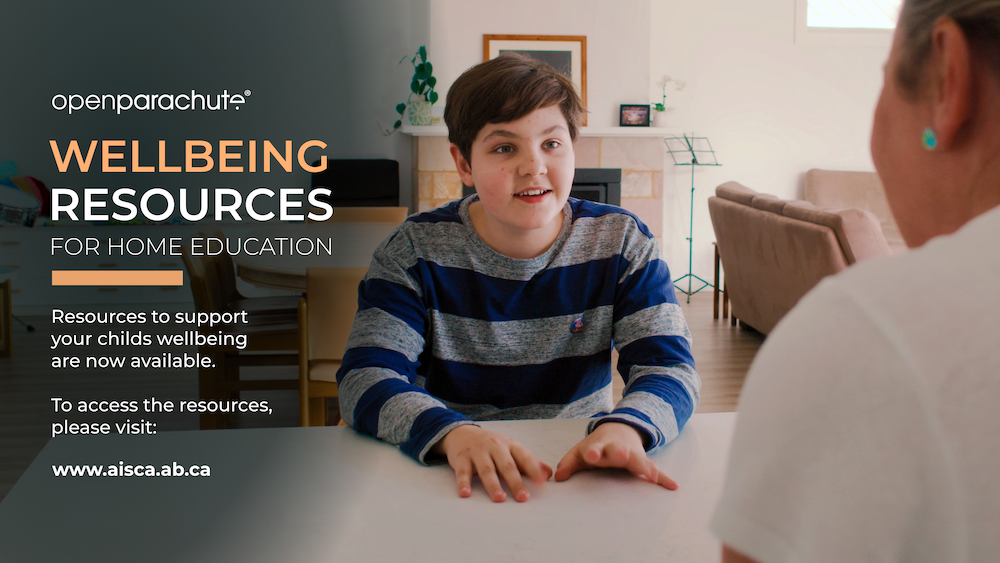
Mental health resources are now available to home schoolers! Open Parachute was initially developed for use in schools, but they partnered with AISCA and home schooling stakeholders (including WISDOM) to create a format that puts parents totally in the driver's seat for their children. You create an account and choose which modules to have your child work through.
Click here to read what home schooling parents have to say about Open Parachute.
Watch the introductory video below, then select 'registration for home education families' and follow the prompts.
Registration for Home Education Families

For a longer introduction, check out this 30 minute information session from AISCA:
Registration for Home Education Families
We collect digital notifications from families in order to streamline and simplify the process for everyone. The SchoolCloud Student Information System (SIS) links specific student data to PASI (Alberta Education's database of student records), and keeps other information private to our staff so we may serve you with excellence. While not mandatory, we invite parents to create your own account, where you may update notifications, view documents (such as evaluations and funding balance) and upload required documents.
Parent Portal FAQ
Q. What is Home Schooling?
Q. What is (Parent-Delivered) Home Schooling? (What are the different types of home schooling?)
Q. Why do families home school?
Q. Are parents qualified to teach their children?
Q. Is home schooling legal?
Q. How much time does it take?
Q. How can we teach several children at once?
Q. What about socialization?
Q. What about my child's special interests?
Q. Can Home Schoolers get a high school diploma and attend university or college?
Q. What materials are available?
Q. What methods should I use?
Q. What about children with special needs?
Q. How does WISDOM receive, divide - and use - educational funding grants?
Q. What are some difficulties we might face when home schooling our children?
Q. How do we get started home schooling?
Q. Are we obligated to create and use this portal for our family? I prefer to keep my personal info out of 'clouds' and other servers.
Q. How will I access student information?
Q. Does this give AB Education access to our Education Program Plans (EPPs)?
Q. Which option we pick for the declaration of outcomes?
Q. We will not be returning to WISDOM Home Schooling (The Gilbertine Academy S2338) for this coming school year. Do we still need an account?
Are we obligated to create and use this portal for our family? I prefer to keep my personal info out of 'clouds' and other servers.
Alberta Education requires that all schools store student records in a government-approved student information system (SIS).
SchoolCloud is highly secure, with the same precautions as any other government database. If you do choose to send us paper forms, which you are still able to do, we enter the necessary information into this database.
SchoolCloud is actually more secure than email, so is thus the preferred means of sharing information with our parents. Your secure login will give you access to your child's notification and private family information. We will send you email notifications when information is changed in SchoolCloud, such as to notify you when your facilitator uploads a student evaluation.
You do not need to access your parent portal if you do not wish to do so, but your students’ information will still exist in SchoolCloud as it always has. Now parents will access and enter information into SchoolCloud themselves, rather than the student information being entered entirely by our team.
How will I access student information?
You will be able to log into the Parent Portal at any time to access your child's records, including facilitator evaluations. We have created tutorials to assist you in creating your account and creating notifications. If you need assistance, the chat function is live during business hours and a member of our team can help you.
Does this give AB Education access to our Education Program Plans (EPPs)?
The official student record (Notifications, ID and Evaluations) are the property of Alberta Education and reside within PASI, synced through SchoolCloud. The student cumulative record follows them through their educational journey and is destroyed 7 years after graduation.
In 2019, AB Education moved to entirely digital student records, meaning that instead of paper files being shipped from school to school to follow a student, student records across Alberta are entirely digital and stored within PASI. If a student moves between schools, the information is transmitted within PASI.
When it comes to preparing excellent EPPs, we assist parents in following the Alberta Home Education Regulation, ensuring that all families are protected in their right to home educate.
Which option we pick for the declaration of outcomes?
Following the Alberta Programs of Study (POS) is what you choose when you plan to follow all the AB Education Programs of Study outcomes for each subject, just as if your student attended school for that particular grade.
Following the Schedule of Learner Outcomes as per the Home Education Regulation allows you to fully develop your own program plan, tailored to the unique needs of your child. With this option, you may follow the Alberta POS as closely as you wish to, but evaluation of your student's progress is based on the outcomes you include in your plan, and not on something external. Most home educators choose this option.
We will not be returning to WISDOM Home Schooling (The Gilbertine Academy S2338) for this coming school year. Do we still need an account?
If you do not intend to home educate with us for the following year, your account will be deactivated. We will retain your personal information as part of your student's past enrollment. The student cumulative record follows them through their educational journey and is destroyed 7 years after graduation.
More Questions? Email data@wisdomhomeschooling.com

“How do I get into a university or college?” “What do I need to get a job?” “How do I show that I’ve had a good high school education through home schooling?” These are common questions that arise when considering high school at home.
Home educated students can take many paths through high school, with differing types of final credentials. A student might consider one or several of the options presented below.
Always research the sort of credentials you will need in the future, in order to assist in planning out a high school education that will meet your individual needs and goals. Your facilitator and our high school advisor are available to assist you in planning a path forward, and choosing an option that best suits your unique education.
Potential credentials a student might consider include (click on any for more information):
- High School Portfolio
- Parent Verified & School Certified Transcript of High School Marks
- WISDOM Diploma or Certificate of High School Completion
- CLT (Classic Learning Test)
- CAEC (Canadian Adult Education Credential)
- SAT (Scholastic Assessment Test)
- ACT (American College Testing)
- Post-Secondary Entrance Exams (specific to the institution)
- Alberta High School Credits & Transcript
- Alberta High School Diploma
High School Portfolio
Portfolios continue to be a strong credential for home educated students. Having a document that says the student has acquired specific knowledge and skills is good, but a portfolio will show how that student has acquired specific knowledge and skills.
WISDOM strongly recommends that every student develop a high school portfolio. There are benefits to having a portfolio in conjunction with any other credential you pursue.
For more information on creating a portfolio, click here.
Benefits:
- Accepted by some post-secondary institutions with an interview.
- Accepted by many employers
- Offers support to any other credential obtained.
- Specific record of the individual student’s work and skills
Limitations:
- Insufficient evidence for some institutions
- Insufficient for some employers
Parent Verified & School Certified Transcript of High School Marks
A Parent Verified Transcript (or Summary of High School Marks / Home Education Record) is an official document containing a table of subjects with corresponding marks or grades of the student’s high school year, as verified by the parents.
This provides parents and students with a personal record of high school achievement which can be used with various post secondary institutions or businesses that require a transcript of high school marks.
Benefits:
- Indicates completion of High School and readiness to enter the adult world
- Specific record of the individual student’s work on a student transcript
- Accepted by some post-secondary institutions
- Accepted by many employers
Limitations:
- Insufficient evidence for some institutions
- Insufficient for some employers
WISDOM Diploma or Certificate of High School Completion
Each home education student who successfully completes high school at home will have achieved the learning outcomes as determined by the parents and approved by the WISDOM facilitator. This student qualifies to receive a WISDOM diploma or a parent authorized Certificate of High School Completion which is an official recognition of high school completion.
Benefits:
- Indicates completion of High School and readiness to enter the adult world
- Accepted by some post-secondary institutions
- Accepted by many employers
Limitations:
- Insufficient evidence for some institutions
- Insufficient for some employers
CLT (Classic Learning Test)
CLT offers assessment tests that suit traditional home educated students. Featuring passages selected from great works across a variety of disciplines, the CLT suite of assessments provide a highly accurate and rigorous measure of reasoning, aptitude, and academic formation for students from diverse educational backgrounds. The exams are taken online in two to three hours.
The CLT provides colleges and secondary schools with detailed information about student learning trends to facilitate decisions about admissions, curricula, and instruction. The CLT3-CLT10 may be used in grades 3-10 to measure student progress, and the CLT in grades 11-12 as a college entrance exam. A number of post-secondary institutions offer scholarships to students who use the CLT. WISDOM students receive a special discount on CLT test fees.
Click here to view test dates and register for CLT tests
Benefits:
- Access to many colleges and universities
- Potential consideration for specific scholarships
- Provides comprehensive student assessment
- Tests are designed with homeschoolers in mind
- Tests are taken at home at a time chosen by family
- Tests are discounted for WISDOM students
Limitations:
- May not allow direct access to the program you have selected; additional research is required
CAEC (Canadian Adult Education Credential
The Canadian Adult Education Credential (or CAEC) is a high school equivalency diploma in Canada for those who do not have a high school diploma and are seeking access to employment prospects, education pathways such as trades programs, and training opportunities. Students should confirm directly with prospective employers, post-secondary institutions and others that the CAEC meets their job or admission requirements. CAEC tests can be taken over an extended period of time, and results never expire. Each test generally costs 75$ for a total of $375 for all 5 tests.
In order to determine basic high school equivalency, the CAEC battery of 5 tests includes:
- Reading
- Writing
- Science
- Social Studies
- Mathematics (Part I and Part II)
Registration
To write a CAEC test, you will need to create a profile within the CAEC digital platform.
On this platform, you can schedule a test at a testing centre of your choice and pay fees.Testing centres can provide more information about registration deadlines, fees and test dates.
Please use the links below to access more information on writing centres, general information, practice tests, study materials, and test previews.
CAEC Digital Platform Alberta Testing Centres
Eligibility:
To receive a High School Equivalency Diploma by writing CAEC tests, a person must meet the following eligibility requirements:
- Be 18 years of age or older.*
- Have been out of school for at least 10 consecutive months.*
- Have an Alberta Student Number.
- Must provide two forms of valid identification (ID) at the time of testing.
- Pass all five tests in the CAEC test battery, with a minimum passing score of 55% or higher for each of the tests.
*Pre-Adult CAEC Registration
The CAEC is meant for mature students and adults, however, a 17 year old student still in school can take the CAEC prior to graduation, providing that they have less than 80 credits awarded for high school courses. To take the test at 17, please reach out to WISDOM for guidance.
Benefits:
- Access to trade schools and college programs
- You may achieve the diploma while using supplemented home education curriculum
Limitations:
- May not allow direct access to University
- Time spent fulfilling requirements & writing provincial exams
SAT (Scholastic Assessment Test)
The purpose of the SAT is to measure a high school student's readiness for college, and to provide colleges with one common data point that can be used to compare all applicants. Used primarily for American colleges and universities, it is also accepted at most Canadian institutions.
Benefits:
- Access to many colleges and universities
- Potential consideration for specific scholarships
- Free digital SAT prep resources available through Khan Academy
Limitations:
- SAT tests offered in limited locations (Click here for more info)
- May not allow direct access to the program you have selected; additional research is required
ACT (American College Testing)
The ACT is the leading U.S. university admissions test, measuring what students learn in high school to determine academic readiness for university. It may be used for access to American programs, as well as over 200 additional institutions worldwide.
Benefits:
- Access to many colleges and universities
- Potential consideration for specific scholarships
Limitations:
- May not allow direct access to the program you have selected; additional research is required
Post-Secondary Entrance Exams
Many programs and post-secondary institutions have their own entrance exams for student admission. This can be a good option for home educated students who have followed a unique education suited to their needs, but do not have specific provincial course credits for admission requirements. Speak with an admissions coordinator of the institution of your choice to see if this is an option.
Benefits:
- Access to many colleges and universities
- Allows access to some institutions while having followed a unique home education program
Limitations:
- Entrance exams are specific to the institution they are taken in. These generally will not grant access to other institutions.
- May not allow direct access to the program you have selected; additional research is required.
- Not every institution has entrance exams; additional research is required.
Alberta High School Credits & Transcript
Alberta transcripts are used to enter post-secondary programs that require select
course marks. To gain Alberta high school credits in home education, students will need to participate in course challenges and/or gain waived prerequisite credits.
- Meet course requirements using your own home school program or Alberta Education materials.
- Work with the Subject Specialist or your Facilitator to achieve the requirements of the course. Evaluation is completed using portfolio, oral evaluation or a final exam to arrive at the school-based mark for each course being challenged.
- WISDOM registers the school-based mark and credits with AB Education.
- Student writes the Alberta Diploma exam, worth 30% of the final mark.
- The combined final mark and credits appear on the student’s AB Education transcript.
Alternative Option: Student can take up to 10 credits per year through a distance education provider rather than have the parent deliver the course. Click here for more information.
Benefits:
- Accepted by all universities and many colleges
- Use your own teaching methods and resources
- Receive Alberta credit for skills and knowledge
Limitations:
- Some trade or technical schools require an AB Diploma (ironically requiring less rigour but more detail)
- Home school resources often need to be supplemented
- Demonstrating achievement for AB Ed outcomes may leave less time for the student's other passions
Alberta High School Diploma
Students in home education have the option of obtaining the Alberta High School Diploma by achieving certain Alberta High School Credits. For this option, students will need to speak with their facilitator as early as possible and plan a course load so as to complete the following, with a minimum of 100 credits:
- English 30-1 or 30-2 (or Français 30-1 or 30-2)
- Social Studies 30-1 or 30-2
- Mathematics 20-1, 20-2, or 20-3
- Science 20 or 24, or Biology 20 or Chemistry 20 or Physics 20
- Physical Education 10 (at least 3 credits)
- Career and Life Management (at least 3 credits)
- 10 credits from CTS courses or Fine Arts, or second languages, or Phys Ed 20 or 30, or the Registered Apprenticeship Program (RAP currently not available to home educated students)
- Knowledge and Employability
- 10 credits in any additional 30-level courses.
- Write AB Diploma exams for a minimum of English 30 and Social Studies 30.
To gain Alberta high school credits in home education, students will need to participate in course challenges and/or gain waived prerequisite credits, and/or take distance education courses through a school. If the student is 19 as of September 1, you may choose the Mature Student option of challenging Diploma exams, worth 100% of the final mark.
Benefits:
- Access to trade schools and college programs
- You may achieve the diploma while using supplemented home education curriculum
- Accepted by many employers
Limitations:
- May not allow direct access to University
- Time spent fulfilling requirements & writing provincial exams
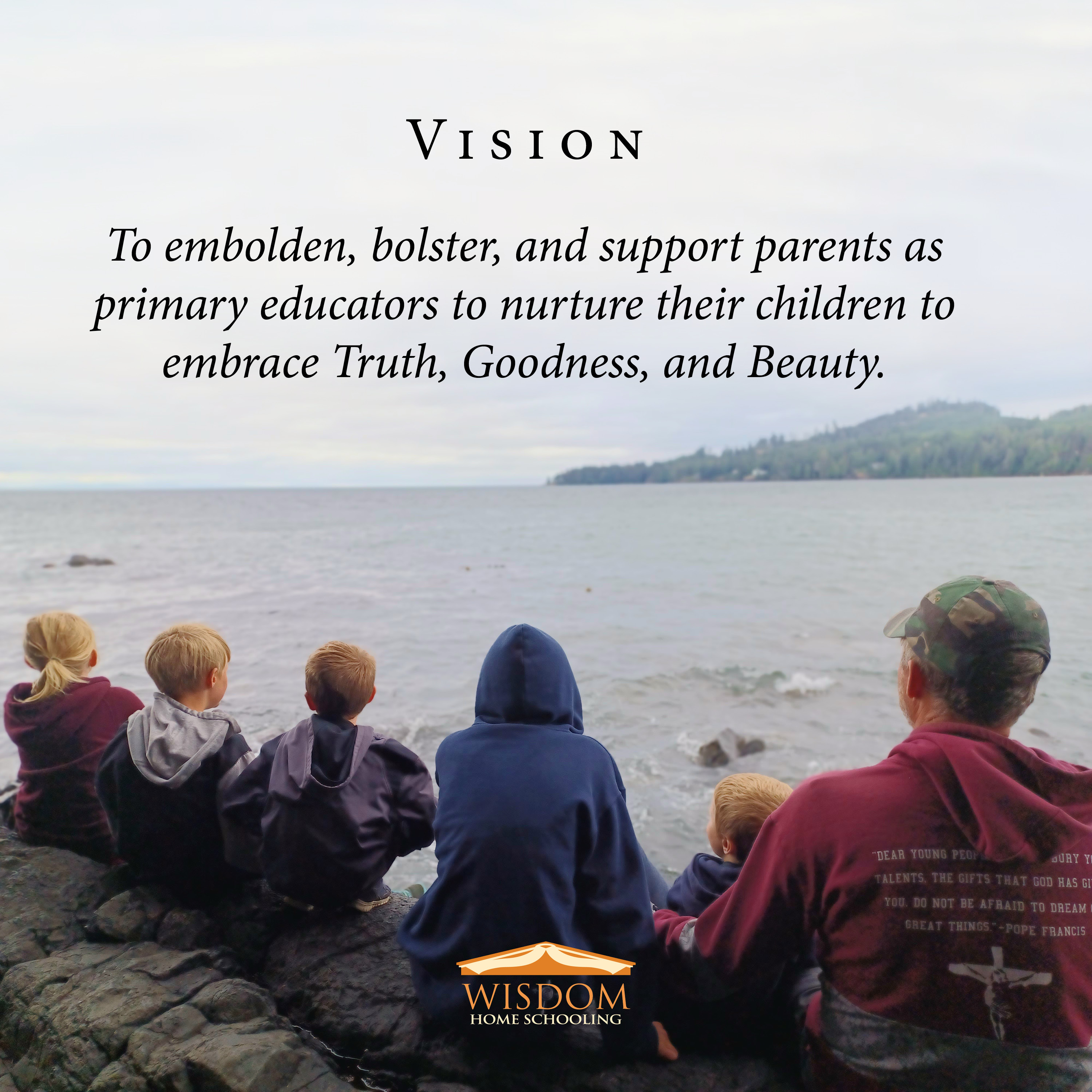

The WISDOM Home Schooling community began in 1995 when two home educating couples saw the need for parents to be supported with maximum freedom over their own schooling at home, deciding what is taught to their children, as well as how and when it is taught.
As a result of the founders' promise to uphold parents as primary educators, all decisions and policies are developed with the intent of supporting parents as they educate their children. Because the members of our facilitating team, our office staff and our Parent Advisory Council are home schooling parents or were home educated themselves, their responses and service reflect this insight and commitment. We support all teaching methods from highly structured to unschooling, classical to eclectic to world-schooling.
We are Christian, serving families with a wide variety of religious beliefs, as well as families who do not profess any particular faith. Our mandate is to build culture through supporting home education and family life, whatever that looks like for you. We serve home schooling families everywhere in the province of Alberta, Canada.
Looking for more information? Attend an Open House event.
WHAT IS REQUIRED
To home educate with WISDOM, a family must:
- Notify us of your intent to home educate with the WISDOM Home Schooling department of The Gilbertine Academy.
- A parent must conduct an evaluation of the progress of the student at regular intervals and maintain a record of the methods and dates of those evaluations, and must maintain dated samples of student work and a general record of the student’s activities, (Alberta Home Education Regulation 4(1)(a))
-
meet for two facilitator evaluations each year, either in their home or in a mutually agreeable location.
We work with individual issues and extenuating circumstances as best we can. Every situation is unique, and we desire to serve our families at their individual needs.
Note: when a family does NOT meet minimum requirements above despite best efforts, The Gilbertine Academy is unable to meet the minimum requirements of Alberta Education. In this case, we would not consider enrolment for the following year, and may make a note in the student file recommending a program with higher levels of accountability. This policy protects the freedom of all home educators.
WHERE ARE WE?
- The Gilbertine Institute is an independent school authority, operating three schools including The Gilbertine Academy, and supervising and supporting home education programs under the banner of WISDOM Home Schooling. Our society board, in-school and home education administration and staff are wholly supportive of home education. Head office for The Gilbertine Institute is in Derwent.
- WISDOM is made up of home schooling families all across Alberta, so in that sense, WISDOM is "everywhere"! Some of our families, while Alberta residents, are living temporarily (military, travel or ministry) all over the globe. Our magazine has subscribers from all around the world as well.
- You can find the WISDOM office staff working out of the home education office near the small town of Derwent, Alberta.
- Your facilitator probably lives somewhere reasonably near you, as we do try to keep them closer to their home (and their own home schooling family). Our facilitators live all over Alberta. They visit your home twice a year, and are also available via phone and email at all times.
- Our in-person events span the province, wherever there is enough interest and a suitable location.
- Our Mediated Learning Program holds workshops province-wide as well as in 3-session online modules.
We are also on Facebook, Instagram and X - join us!

Your agreement is required upon registration for the workshop. By agreeing to the Terms and Conditions for the workshop, you agree to uphold the following guidelines.
These guidelines are intended to create mutual trust and integrity to cultivate an excellent learning environment.
- Always treat fellow participants and your tutor with respect and courtesy.
- Appropriate language and behaviour is expected at all times.
- Arrive on time, having done your assignment.
- While the class is in session, please do not use the chat box for distracting conversation. Chat box text should pertain to the discussion at hand.
- Parents and students should be aware of Internet dangers and concerns. Please be mindful of the need for good security and wise Internet use. When in the classroom, do not surf the net. Do not refer other students to outside websites. Instant messaging/private messaging is not allowed during class time.
- Do not give other students’ email addresses out to anyone. With parental permission, students are allowed to share their own emails with other students at an appropriate time specified by your tutor.
- Every paper or report submitted must be the student’s own work. Wording should be the student’s own. Quotes from lectures, Internet sources, books, articles, and other writers’ phrases or sentences must be “sourced” or stated. Plagiarism is a serious offense; it is the student’s responsibility to be aware of what plagiarism is and to avoid it. If a student plagiarizes, they will be given a single warning and will need to meet certain requirements given by the tutor (e.g. submitting work in progress, etc.). A second instance of plagiarism will result in the student being removed from the workshop.
- Assignments must be remitted on time. A tutor reserves the right to not grade a late assignment unless the student has received prior authorization from the tutor for a deadline extension.
- Content should be of a quality that does not glorify violence, gore, the occult (including possession and spells), or any imagery or presentation that diminishes the dignity of the human person. Good writing does not rely on explicit depictions of tasteless or immoral content. In striving to imitate the great classical writers, students will strive toward high standards and wholesomeness.
- Improper language, swearing, or words that insult human dignity will not be accepted in any WISDOM writing workshop.
- Students will be required to follow specific formatting requirements for their assignments as detailed by the tutor.
- Tutors may refuse evaluation, grading, or guidance when presented with writing that does not meet WISDOM criteria.
- If you have any concerns regarding behaviour in the workshop, please contact Nicole Noster at: 780-549-4008 or email: nicole@wisdomhomeschooling.com.
- Students who do not comply will be given one warning by the tutor and will be given opportunity to correct their behaviour. Second infractions can result in the student being asked to leave the workshop.
When families face difficulties, they are encouraged to seek the assistance of their Facilitator or other WISDOM Staff. In the event that more help is needed, or a situation requires more intensive support, WISDOM has an in-house Family Mediational Consultant (FMC). This service is part of WISDOM’s Mediated Learning Program.
She will draw from her education and experience and use a mediational approach to assist you in getting to the root of difficulties and working toward solutions.
Michelle can walk alongside families and provide mediation as they work to achieve:
- Problem solving
- Resolution of family and marriage difficulties
- Solutions to home schooling and parenting challenges
- Conflict resolution
- Reduction of discouragement and burnout
- Transitions from addictions (some forms of addiction require intervention beyond WISDOM's service)
This service is offered by donation, though financial appeal may be made.
For more information contact Family Mediational Consultant, Michelle McLay at: 587-588-8839 or by email to mmclay@wisdomhomeschooling.com